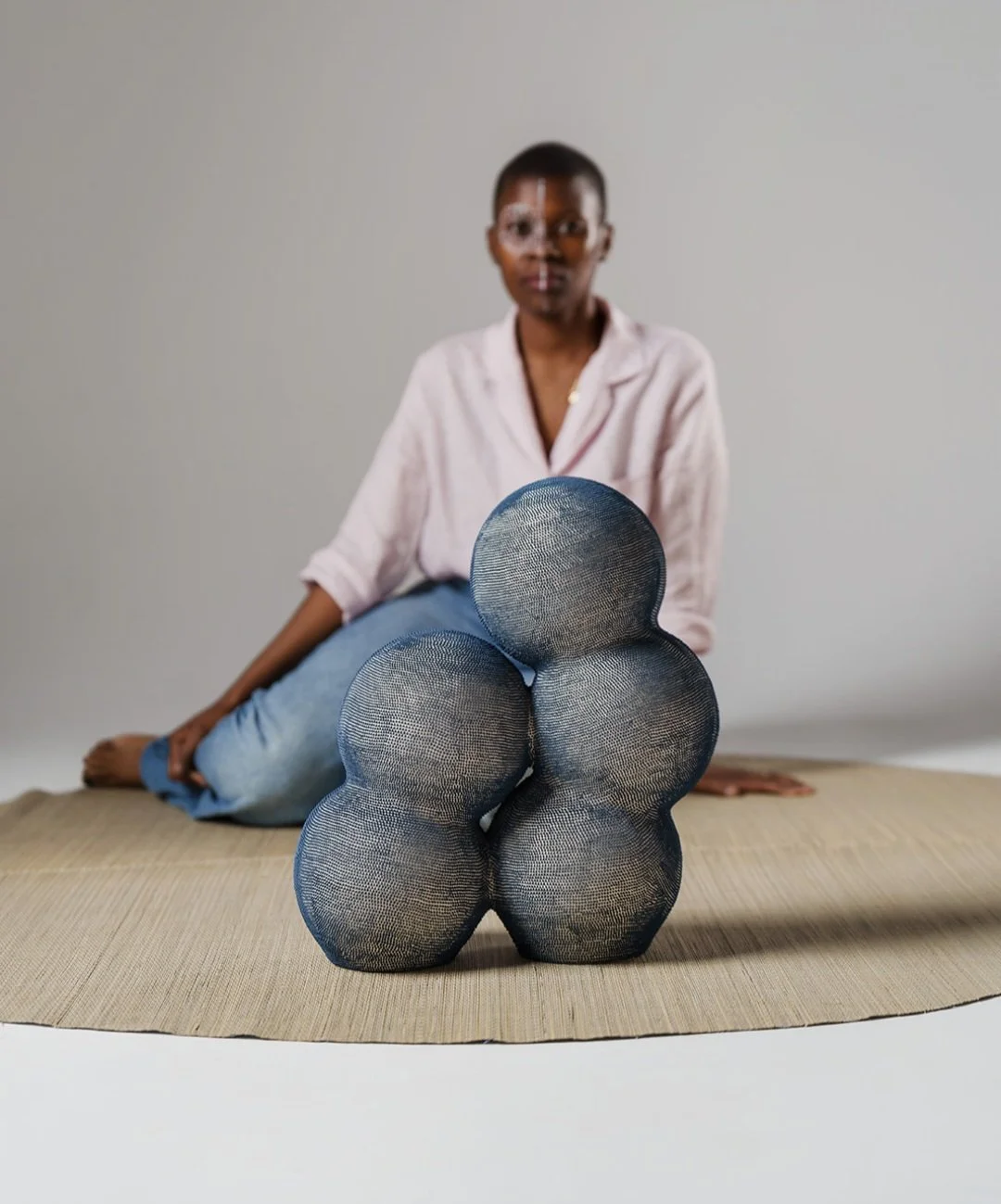
BIO
Isabel Luis Grossenbacher is a Mozambican-Swiss artist whose practice is based on cultural observations and memories. She grew up in a family environment deeply connected to the arts, where creation was affirmed as a form of thought and continuity.
Between the ages of 8 and 12, she attended the School of Visual Arts in Maputo, an experience that marked the beginning of a conscious and structured exploration of art.
In 2020, she moved from Switzerland to Portugal, and in 2021-2024 she enrolled in the Ceramics course at Ar.Co — Centro de Arte e Comunicação Visual, deepening a practice that finds in clay a territory of listening, resistance, transformation and resilience.
She currently lives and works in Setúbal, where she has her studio. Her work develops from the relationship between cultural heritage and identity development, summoning ancestry as an active presence and questioning the place of women in the historical, political and symbolic process. Her work is part of a dialogue between matter and memory, gesture and permanence.
Artist Statment
The conception of my pieces stems from a personal confrontation with finitude, an encounter with limits and with that which reminds us that we are merely passing through. From this confrontation questions arise: what remains, what do we leave behind, and what do we inherit?
I turned my gaze to Mamanas, a term used in Changana, the local language of Maputo, Mozambique to refer to older women. More than just “mother” or “lady,” mamana signifies respect, recognition, and experience. These are women who carry the memory of time in their bodies and in their gaze. To the younger generation, I am already a mamana, and in this recognition there is continuity.
This work stems from a reconnection with my ancestry. The sculptures are a tribute to the women who came before us, who paved the way, sustained lives, and made possible the place we occupy today.
In Mozambique, we sit in a circle, around tea, a space for sharing, celebration, and mourning, where women recognize one another.
The sculptures, arranged on the floor, form this circle. We are observers, until absence calls us: a woman faces her end, and we take her place. We become part of the circle. Finitude is not an ending, but the continuity of the circle, where memory, transmission, and the quiet persistence of what remains endure.
And so, we go on, generation after generation, passing on memory, care, and strength, an invisible thread that binds us through time.